
Clinical research leaders often cite regulatory compliance, data integrity, and budget or resource constraints as their most pressing challenges. While these issues are frequently addressed independently, the reality is that they are deeply interconnected—and failure to manage them holistically can undermine even the most promising trials.
Modern clinical trials operate within extraordinarily complex environments. A single study may require the integration of dozens of technology systems to collect and manage patient data. When scaled across multiple trials, therapeutic areas, and geographies, this complexity grows exponentially. Each system integration introduces potential points of failure, increasing the risk of data discrepancies and compliance issues.
We surveyed 500 industry executives, and what we uncovered shows an industry that’s eager for growth, optimistic about the future and the potential new technologies may offer but also confronted by some familiar challenges.
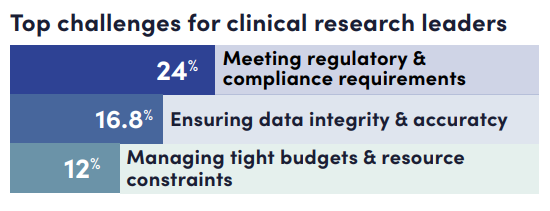 Key Findings from our recent pulse survey in which we surveyed 500 industry executives.
“Each of these may seem like discrete challenges in their own right, but they’re actually interconnected throughout the clinical trial process,” said Antony Goncalves, Managing Director of Clinical Data Sciences for Eliassen Life Sciences Solutions.
Regulatory requirements further compound the challenge. Expectations vary not only by country, but by product type, indication, and trial phase. Guidance continues to evolve, often in response to new technologies and trial methodologies. For sponsors, this creates an environment where long-term planning is difficult and adaptability is essential.
Regulatory change isn’t a disruption—it’s a constant.
Resource constraints add another layer of pressure. Tight timelines, limited internal expertise, and competition for skilled talent can strain trial execution, particularly when unexpected regulatory or data issues arise.
Despite these challenges, industry leaders remain optimistic. Advances in digital tools, analytics, and trial design offer real opportunities to reduce friction and improve oversight. However, realizing these benefits requires more than new technology. It demands operating models and partnerships that are designed to manage interdependencies, provide visibility, and respond quickly to change.
As trials become more complex, success will increasingly depend on a sponsor’s ability to orchestrate people, processes, and technology as a cohesive system—rather than addressing challenges in isolation.
Read our full whitepaper, "Promise and Peril: Navigating What's Next in Clinical Research," to see what else we discovered in our pulse survey and learn how biopharma directors and C-suite leaders are overcoming compliance hurdles, leveraging AI, and moving past under-performing outsourcing models to drive true R&D efficiency.