
Outsourcing remains a critical component of clinical trial execution, and most sponsors plan to continue leveraging external partners in the years ahead. We surveyed 500 industry executives, and what we uncovered suggests that many organizations are reevaluating not whether to outsource, but how.
Outsourcing is evolving—from convenience-driven decisions to strategy-driven partnerships.
Traditional full-service CROs have long positioned themselves as one-stop shops, offering end-to-end trial management and operational simplicity. For some sponsors, particularly those with limited internal infrastructure, this model can be appealing. Data security and regulatory compliance are often cited as key reasons for selecting a CRO partner.
Yet satisfaction with the full-service model is far from universal. Many sponsors—especially small to mid-sized organizations—report feeling deprioritized within large CRO portfolios. Common concerns include limited visibility into trial operations, inflexible processes, slow response to change, and inconsistent quality driven by junior or misaligned staffing.
As a result, interest in standalone functional service providers is growing. Sponsors working with FSPs often prioritize cost-effectiveness, access to specialized expertise, scalability, and control. Unlike traditional CRO engagements, FSP models allow sponsors to retain oversight of their trials while augmenting internal teams with highly targeted support.
“Many sponsors outsource entire trials to CROs through their full service offering, but sometimes, the FSP model is a better fit. While CROs also have this option, it’s not their primary focus due to the fact that 90% of their business focuses on the full service model” Bené said. “This is why, when functional outsourcing is needed, a standalone FSP provider is a better choice. They’re more dynamic, cost effective, and a higher-touch option.”
Despite this momentum, misconceptions persist. Some organizations assume FSPs operate like CROs or view deliberate staffing approaches as a sign of delay. In practice, leading FSP providers focus on deploying the right expertise quickly and embedding resources within sponsor teams, delivering productivity and transparency from the outset.
The future of outsourcing isn’t about doing everything—it’s about doing the right things, with the right partners.
“Outsourcing doesn’t have to be one-size-fits-all,” Goncalves stressed. “In fact, it shouldn’t be. The right provider should be able to deliver a solution that meets the needs of the organization, the trial itself, and the regulatory and market environment of the moment. As a result, we frequently hear from pharma leaders who are ready to reconsider their outsourcing strategies and form more strategic partnerships.”
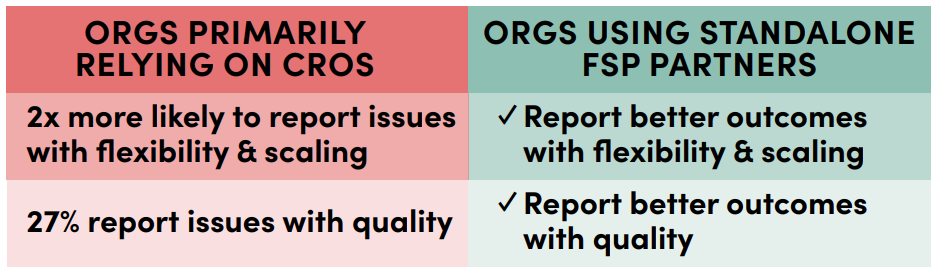
Key Findings from our recent pulse survey in which we surveyed 500 industry executives.
The takeaway for clinical research leaders is clear: outsourcing does not need to be a binary choice. As trials grow more complex and expectations rise, sponsors are increasingly seeking partners that offer flexibility, visibility, and strategic alignment. Those willing to rethink traditional outsourcing models may find themselves better positioned to manage risk, improve quality, and accelerate delivery in an increasingly competitive landscape.
Read our full whitepaper, "Promise and Peril: Navigating What's Next in Clinical Research," to see what else we discovered in our pulse survey and learn how biopharma directors and C-suite leaders are overcoming compliance hurdles, leveraging AI, and moving past under-performing outsourcing models to drive true R&D efficiency.

.png)