The clinical research industry is at a pivotal moment. Pharmaceutical sponsors face a rare combination of extraordinary opportunity and significant risk, creating an environment that demands both boldness and discipline. Advances in science and technology are unlocking new possibilities for faster, more efficient drug development, while economic, regulatory, and competitive pressures continue to test traditional operating models.
Clinical research leaders are balancing unprecedented opportunity with unprecedented risk—and the margin for error has never been smaller.
On the opportunity side, innovation is accelerating at an unprecedented pace. Artificial intelligence and machine learning are being applied across the clinical development lifecycle, from protocol design to patient recruitment and real-time monitoring. Digital twins and advanced analytics are opening the door to more predictive trial planning. Meanwhile, therapies such as GLP-1–based treatments for obesity and diabetes are already delivering massive commercial returns, reshaping portfolios and investor expectations alike.
At the same time, the industry faces sobering realities. The Inflation Reduction Act is beginning to reshape pricing and reimbursement dynamics, placing downward pressure on long-term profitability. Patent cliffs are looming for several blockbuster therapies, while competition from generics and biosimilars continues to intensify. Despite technological progress, the cost of bringing a new therapy to market still averages more than $2.3 billion, and clinical trial failure rates remain stubbornly high.
Scientific innovation alone is no longer enough—operational strategy is now a critical driver of success.
Against this backdrop, the stakes for clinical research organizations have never been higher. Decisions around trial design, technology investment, and outsourcing partnerships now have direct implications for speed to market, capital efficiency, and competitive advantage.
To better understand how leaders are responding, we surveyed500 industry executives, and the results reveal a sector characterized by cautious optimism. Sponsors are eager to grow, willing to invest, and increasingly open to rethinking how clinical trials are planned and executed. At the same time, they recognize that familiar challenges—regulatory complexity, data integrity, and resource constraints—have not gone away.
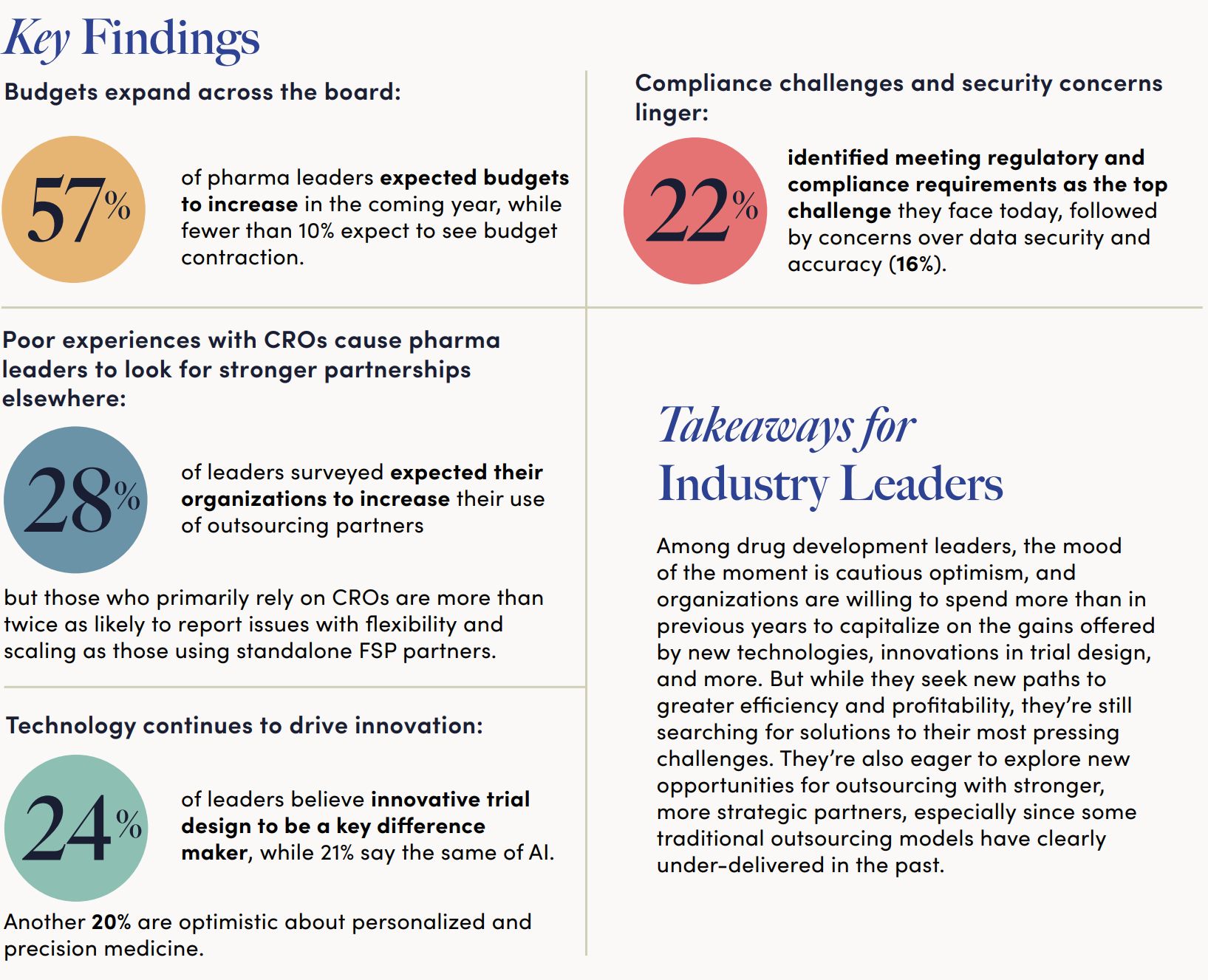
Key Findings from our recent pulse survey in which we surveyed 500 industry executives.
What emerges is a clear message: navigating the next phase of clinical research will require more than incremental improvement. It will demand new ways of working, more strategic partnerships, and a willingness to move beyond one-size-fits-all models in favor of approaches that reflect the complexity of today’s trials.
-reg-1.png)